
A Powerful Revelation of God
previously published in June 2007
I remember going camping in the coastal mountains near Los Angeles as a young Pathfinder. With my then "greenness" to the world, I easily overlooked the obvious urban encroachment into the "wilderness park" at which our church group had reserved campsites. The creek that flowed through the campground – a mere trickle because of a dam built miles upstream - seemed full of life and adventure with tadpoles, minnows, frogs and salamanders. The beachside pond, just 50 yards away – really just a small lagoon of semi-stagnant, brackish water fed by that trickle of a creek and breaching spring tides – provided a quiet (albeit turbid) alternative to the crashing waves of the ocean. The honeysuckles – planted alongside the campsites - provided an exotic and "wild" source of sweet nectar. But the crowning moment came when I experienced complete wonder and amazement at seeing a billion stars suddenly made visible by a combination of physically being removed from the haze of city lights and a rare, clear early summer night along the Pacific coast. So, upon returning from a visit to the restroom, I found myself standing outside my tent at three am, "whisper-yelling" to my friends to get up and see the vast array as if God had just created the cosmos. Even the very pronounced and vocalized irritation of the older tent leader couldn't extinguish the awe I was experience – that is until I was forced to go back to sleep. Yes…I was a suburbanite through and through, and while others in more rural areas might have found the experience hardly noteworthy, it was eye-opening to me.
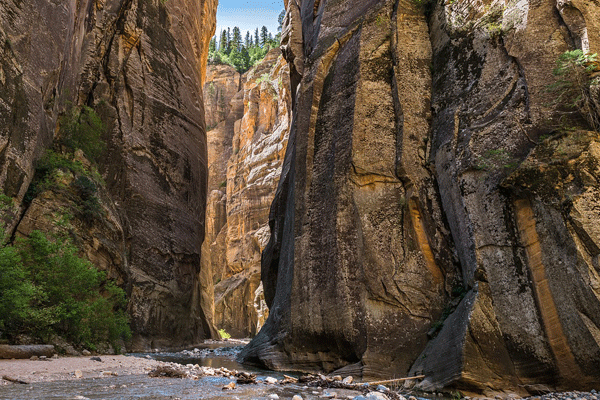
Years later, as an art student, I took a trip to Zion National Park (with that same church group, by the way) and experienced the intimidating scale and grandeur of the Virgin River Narrows on a one-day hike that ended all too quickly. As I stood thigh-deep in a water-carved canyon, which at times stood over a thousand feet deep and less than thirty feet wide with no banks, the dim of the canyon's half-light with only a crack of sky visible while looking up gave me such an overwhelming sense of awe that I returned a couple of summers later to do an overnighter. On my return visit, I was pleased to find the encounter as potent as with my first visit (visit [url=http://www.michaelchung-design.com/photoalbums/zion-narrows/]http://www.michaelchung-design.com/photoalbums/zion-narrows/[/url] to see pictures from my second visit).
It is no surprise to me that the Bible, the early Church writings and our own Ellen White found the natural world to be such a powerful revelation of God. And all this came before the agenda-ridden concept of "Intelligent Design." To me, it matters little whether or not the world was created literally in six days or by a God-initiated process of evolution. This is because in the end, nature is right near the top of my list of things that positively affirm the existence and actions of God. Religion (yes, even Adventism) and people can disappoint. But nature? Hardly so. Many times in my life I have had my faith and spirituality redeemed by communing with God in nature. This is the power of nature.
Being in nature not only reminds me of the amazing complexity of our ecological systems, it also reminds me that I am "wonderfully and fearfully made". Whenever I go hiking – particularly when it involves flyfishing – I am always amazed at the complex ways in which my joints and musculature can be articulated and adapted to varied and constantly shifting terrain. The human body is a miraculous machine, and it shines most brightly when in nature.
We should never underestimate the power of nature to positively factor into our spiritual self-awareness. But we often do. We do this obviously by not spending enough time in nature as a whole. This is not to say God isn't present in the wonderful design and engineering that goes into our urban landscapes. But life isn't all cities and bridges.
We also spite the wonderful gift of nature in indirect ways by not being more conscious and preserving of our environment. Christianity is notorious for its ignorant or even hostile attitude towards ecology. It seems our eschatology (view of end times) can lend itself to the notion that the world itself is not for saving. As Christians, however, this puts us in direct tension with the concept of loving others as ourselves as we are not the only ones who live on this planet. Our actions towards it, therefore, can directly affect the quality of life for everyone else living alongside us. As Adventists, we can encounter even more tension when we are not just stewards of this earth, as we hold to a rather unique eschatology that does not end with the world being destroyed by flame but being renewed and restored as our ultimate and permanent home.
In the book of Ecclesiastes we are reminded that "…Generations come and generations go, but the earth remains forever." Nature stands as a permanent, powerful revelation of God that transcends history or our mortality. While not going as far as worshipping nature itself, I think it would do us much good to nurture a healthy and robust respect for our planet. After all, sooner or later we will all return here for eternity. Think about that.