
Empty Nest and Other Losses
In August of this year, I passed a big milestone in my life. I dropped off my youngest son, Matthew, at Southern Adventist University and my years of being a full-time caregiver to children was finished. Many people told me that being an empty nester is actually a really great time in your life when you can finally enjoy the freedom of not having to care for a child under your roof. Others have told me it’s kind of a mixed bag, a bittersweet experience that mellows into something that eventually is freeing and fun. So I was expecting some kind of ambivalent emotions when I finally became an empty nester.
Being a mother has been my identity for 31 years and especially since I was a stay at home mom, raising children has been my big consuming passion, duty, and mission. When I came back after driving Matthew off at Southern, I was not prepared for the emptiness that I felt in the house and in my heart. The house seemed so eerily quiet. When I would pass the bedroom, it would look the same all the time. The bed would remain ordered, with the blankets straightened and the pillows neatly placed at the head of the bed. Matthew had left the bed unmade and left some empty Vitamin water bottles in the room, and unwashed laundry that did not make it into the laundry basket. All these things should have made me glad that I didn’t have to nag him anymore about tidying up after himself. And I didn’t have to be annoyed that he forgot to bring down the garbage for the pickup that week. I didn’t have to worry about what he wanted for dinner, or whether he dressed himself properly for the weather. Before he left for college, Matthew actually apologized that he was not able to clean up his room and vacuum the car before he left. When he said that I felt a mixture of emotions—resigned that he will never be a really neat person, but proud that he was mature enough to even realize that he should have done these things.
I guess one of the reasons why I felt sad with being an empty nester is that I am not totally free with my time. I am a full time caretaker for my elderly in-laws. And with them, they are transitioning in their lives as well, not a milestone like going off to college, but winding down in their years. They are both 94 years old. And they are relatively functional for their age but they still have some serious health problems. They can still eat by themselves, walk by themselves, use the bathroom and can express their needs—albeit with a lot of trouble. But having lived with them the past ten years, I see how they have declined and get frustrated that I have to treat them like children sometimes. They both have mild dementia and are hard of hearing—both conditions in which I have to repeat myself over and over, and speak unnaturally slow and loud. My father-in-law’s dementia presents itself in a lot of OCD types of behaviors. When he wants to go for a walk outside, he gets himself dressed and wants to go out at that time, even when it’s not convenient for me. It’s almost like dealing with a toddler, except that the individual is going backwards in growth. In child rearing, it’s easier to handle difficulties in their care because you know that you are helping to develop their character, habits, and their bodies. With the elderly, there’s no such hope nor aspirations. There is just the sad expectation of their imminent demise and hope that their ultimate end won’t be prolonged or painful.
And my own mother is much more marked in her dementia. Although I don’t live with her, I see her once a week and it’s difficult to see how her cognition is dwindling. She is 88, younger than my in-laws but her dementia is the worst out of the three. My father lives with her and is her primary caretaker and for a strong, silent, stoic man, he’s finding it hard to deal with her. Her sense of reality is skewed, and often speaks of the dead as living and vice versa. It’s almost comical that she was asking me why her calls weren’t going through—she was pointing to the calculator. The more serious manifestation of her dementia is her accusing people of stealing things, she will even accuse my Dad about that. It is so sad to see the strong, capable, loving, and generous woman who raised me, turn into someone so opposite of that.
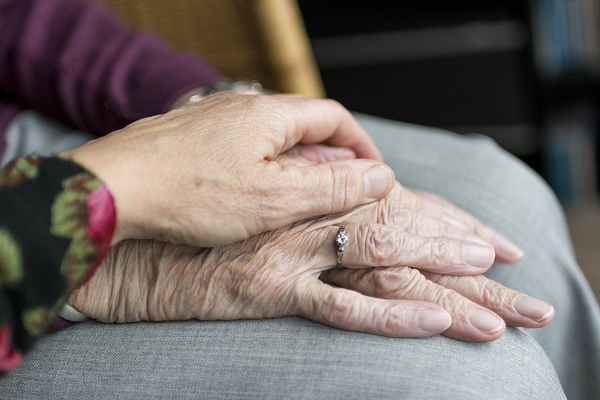
With all these different transitions going on around me, you would think that my life is morose and without joy, nor hope. On the contrary, I am very joyful and thankful. I praise God that my parents and my in-laws are still living and have each other in their golden years. I often see my in-laws holding hands even while they are napping on the couch. My father-in-law is on the alert to fill up my mother-in-law’s water bottles, as soon as she finishes drinking one. It’s sweet and touching to see how they do their best to care for each other in their old age.
I’m thankful for my relationship with my mother-in-law that she has grown to be more trusting and grateful to me. When I first moved into her house ten years ago, there was much more friction and criticism. Often she will write on a piece of napkin (her preferred mode of communication), you are a good daughter-in-law.
Despite my father-in-law’s OCD ways, he is impeccably kind to me and always expresses thanks for taking care of him. Whenever we come back from a walk he says, "thank you for helping me to take a walk!"
As for my mom, even though she’s not what she used to be, I’m so thankful that I have her on this earth. That in her old age, I’m the one that she asks to come when she’s feeling low. I’m thankful that I live within driving distance from her, so that I can see her once a week.
And yes, I miss Matthew but am happy knowing that he’s in a good environment where there is so much spiritual support and love, and that my daughter, Victoria, and her husband live near.
Most of all, I feel blessed knowing that God’s love and care for all my family is always going to be better, than my own care for them. Even though the future is unknown and can be scary for people with dementia, I have confidence that God will strengthen me, and my mom, and my in-laws. “For I know the plans I have for you, declares the Lord, “plans to prosper you and now to harm you, plans to give you hope and a future.” Jeremiah 29:11.