
I am a Hyphenated American. Are You?
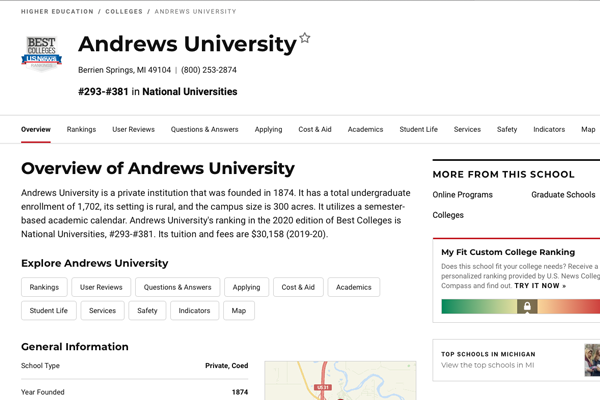
I am currently in my last year at Andrews University, the flagship institution of the Adventist church. And while it is indeed most recognized for its Adventist affiliations, another component was recently brought into the spotlight: in 2017, the U.S. News and World Report website ranked Andrews as the most diverse school. This was a huge moment for the institution, as it was one of the few times we were ranked (and recognized on a national scale) so high. Indeed, if you live near Andrews or know someone that attends it, there’s a chance you’ve heard the claim before, that “Andrews is a diverse university.” To be ranked as number one in something, and in a worthy category nonetheless, was something we could be proud of.
This multiculturalism on our campus, however, presents a problem to those claiming that Andrews is diverse. How may one properly unify such an eclectic group of student and staff? When an artistic urbanite attends class alongside a small-town international student, how can you find a common thread that doesn’t erase the unique differences between them? One solution the administration found is to utilize the statement above: proudly claim that Andrews is diverse. By highlighting this quality, the university can utilize the “unity in diversity” principle: that despite the stark differences within the student body, everyone is still a member of this Andrews family. This way, we can say we are all part of the same place and consider ourselves one unified group. We can say that we are proud of how many different parts our whole is made up of. And perhaps most conveniently when we accept a uniform identity, we can lay aside even our grandest distinctions.
Or, so the idea may seem. Elsewhere besides Andrews, problems arise with this approach of trying to unify too many backgrounds. The country we live in provides many examples of how messy the integration gets. As we have seen nearly daily, the United States contains a plethora of racial-identity related issues, as it is one of the few countries that can claim no real ethnocentricity. And when an institution like itself, or Andrews, brings in that many different groups under one umbrella, what will happen? How smoothly will the various mix of races merge? Questions like these encompass the plight of the hyphenated American; such as the Latino-American, African-American, and other Americans with a clear (or unclear) and distinct heritage or background. The hyphenated American often experiences dual identities, with one life comprised of their American heritage, and the other of their ethnic background. Often, we as hyphenated Americans experience life through two different lenses, which can help us gain unique perspectives.
Yet, what ensues within a hyphenated American’s life is not great opportunity. Instead, confusion, frustration, and identity-insecurity emerge. Because we have one foot in two doorways, we are not welcome to share experiences in either our American or inherited ethnicity’s context. And sometimes, we are simply not welcome as members of either group. How often have American store owners gawked at me when I walked onto their threshold, as they assume me as something different from them. Do they not realize my strong alignment as an American? Yet simultaneously, how often have I also been labeled as the “other” from Asian purists. They believe me to have abandoned ethnic ship and betrayed my homogenous background. Little do they know how proudly
I carry the first part of hyphenated label, Korean -American. Yet, despite my combined lifestyle, I am outcast and ostracized in both contexts. I do not belong to either group, as they do not accept people that embrace dual-cultures. And in what many others as myself also see as the solution, I have given up parts of my identity to feel integrated to both sides. I felt that to be “fully American,” I needed to release an integral part of my inherited self. Hence, I cannot converse in Korean. However, I also felt that to properly mantle my “Asian background,” I had to abdicate parts of my American childhood. That is why I support Korean products in place of American ones. Who knows to what economic extent this impacts my country?
Clearly, part of the problem is how many of us hyphenated Americans feel that to reach an appropriate level of American-ness, we must erase a piece of our heritage. We feel that fragments from our two backgrounds cannot fit with one another. To shed some light on this dilemma, let’s return to the original analogy, the Andrews University label. No one at Andrews has this type of identity crisis. We do not feel torn between our “Andrews University student” tag and other parts of ourselves. At first glance, the “why” is obvious. Part of the reason we don’t have ethnic-identity breakdowns is because we do not deeply attach the school we attend as a large portion of our identity. We don’t buy school memorabilia, we don’t know the names of our administrative board, and we certainly do not know (or maybe even care) about most of the events going on around campus that don’t pertain to us. Most of us come here for less than four years, caring much more about our achievement and ability, rather than the identity designation we receive as “AU students”.
Perhaps it is in this nonchalant attitude of personhood that lies the key to solving the nation’s problem. At Andrews, it is not our ethnicity or background that comprises most of our identity but rather the achievements we have, the relationships we build and the personal touch we have with everyone we encounter. It is not the outside appearance that dictates people’s judgment of who we are, but our persona and mannerism that does. In other words, most of us here care little whether you are from Saigon, Morocco, or LA. What really matters is how you interact with me, which dictates how I will reciprocate.
I cannot help but speculate if this is the simple solution: to see each other as the fully-developed human inside, and prioritize action rather than appearance. Then perhaps the need for labels and the practice of integrating people of “different” races might become outdated. Then perhaps hyphenated Americans like myself will no longer have to struggle with identity. Then perhaps would we set aside our man-made differences, and work towards finding the unity in our diversity. We are all humans; shouldn’t we embrace it?