
Israel the Triumphant
When Israelites talk of their fathers, and speak of Abraham, Isaac and Jacob, Abraham we understand—maybe Isaac as well. But Jacob is not easy to understand. In case of Abraham, we understand although he made some mistakes, just based on one story he may be worthy. When God wakes him up in the middle of the night and says to him, “go and sacrifice your son,” we can see Abraham's worth from his response.
Children have profound impact in your life. Before my son was born, I would say ‘Good Night’ to my wife... face to face. But when I awoke, sometimes it was to her feet that I would say ‘Good Morning.’ I had bad sleep habits. I would at times kick my wife. I would snore so loud I would wake myself up. I would travel all over the bed, end up lying in opposite direction from when I started my sleep and wake up with my wife's toes in my face. I even fell off our bed once or twice. However, after my son was born and he started to sleep between my wife and I, my sleep habits changed. I would lay straight as a log and would sleep that way all night. At least I tried to. Children have profound impact on the parents.
People say the later you are in age when you become a first-time parent, the more doting you are. I can see that. I have a cousin who is 41 and he just became a first time father this year. We saw him in April. He lives in San Francisco and brought his daughter over to his parents. I went over to see them. I could see my cousin was so happy and proud. He kept on handing his daughter over to me asking, “Do you want to hold her?” You can't say ‘no...’ Children have profound impact on their parents.
When God comes to Abraham...an old man (an old man who already chased out his eldest son; an old man facing death but seeing how young Isaac is) God comes to this Abraham and tells him to go sacrifice his son. And Abraham's response in faith is incredible. Abraham's response shows us why he is called Father of Faith. So, when the Israelites call upon their ancestors and call upon Abraham as their forefather, I understand that.
When you look at Isaac, you sort of understand as well. Not too much is written about Isaac and his life but we see that he was an obedient son. And we see from the story of sacrifice, the Isaac had tremendous faith in God as well. We can see why he may be included in the refrain of “Our forefathers…”
But what about Jacob? Why is he included? He does not seem as someone worthy of such title. When you look over his life, he made many mistakes. Actually, more than mere mistakes, he purposefully devised clever plans to cheat and lie to his family/relatives/in-laws. It seems Jacob had this tendency from the time he was born, to the time when he passes from this life. He kept on cheating his brother. He lies to his father. After cheating his brother and father, one may think his bitter separation from his loving mom may teach him a lesson or two. But he does not stop. He devises plans to cheat his uncle/father-in-law and cousins/brothers-in-law. Along the way, he is cheated also. Jacob's life is not a simple one. But so much of his life's complications he brought on himself, by his devise; such as when he married not just the two sisters but had children with their handmaidens—bringing discord within the family.
I think we could say Jacob was fairly intelligent. The scheme that he concocts to cheat his uncle out of sheep is nothing short of brilliant. He somehow understood genetics. I don't understand his scheme of exposed almond, poplar and hazel tree branches at the watering hole, but he made it work. He was brilliant. Laban acknowledges Jacob made his flock massive. (Gen 30). And somehow with the exposed tree branches he exploits a way to somehow take advantage of the arrangement he made with his uncle. Jacob is a bright person, perhaps brilliant. And he relies upon his bright intellect. But somehow his plans were seem always 2% short.
In case of cheating his father and brother, he never ends up with the physical wealth. Jacob runs away with nothing. As he returns to his homeland, Esau comes at him with 400 men. Esau was probably well off due to the inheritance he received from his father and grandfather. When Jacob ran off, all of Abraham and Isaac's wealth became Esau's. So, if Jacob's plan was to inherit material wealth, he failed. Let's look at the rest of his life. Because of his plans, he never got to see his mom alive again. He had to work many years for the woman he loved. He became enemies with his uncle and cousins. In fact, Jacob causes trouble from the moment he is born until the day he dies. He comes out grasping Esau's ankle, and blesses Ephraim, although Joseph asks Manasseh to be blessed. He is this kind of a person. He was born a certain way and never really changed until the day he dies. Why is this person our “Faithful Father?”
There is only one reason; one thing that does not change in his life. One idea, one understanding he kept with him: his faith from the beginning, from the time of Bethel and the ladder, “God is with me and I will not let Him go.”
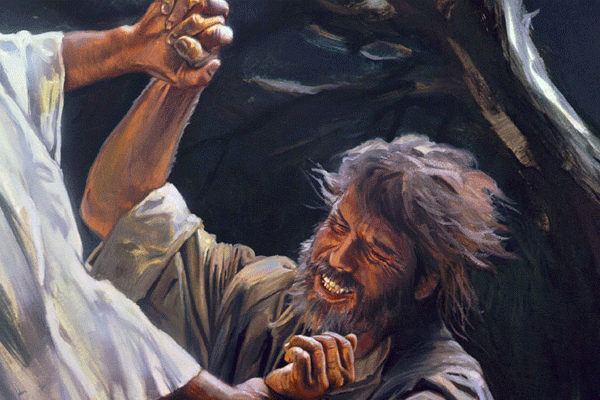
With such faith, he wrestles with the messenger of God in Gen 32. There is no hope of tomorrow. It was day of reckoning. His brother was coming with an army of 400. There was no hope of survival. But Jacob does not give up, nor give in. He holds on to the idea that God is with him and that he, Jacob, will not let go of God.
This is how Ellen White describes Jacob's life:
“Jacob had sinned, and had deeply suffered. Many years of toil, care, and sorrow had been his since the day when his great sin caused him to flee from his father's tents. Distressed by his daughter's shame, by her brothers' revenge, by the death of Rachel, by the unnatural crime of Reuben, by Judah's sin, by the cruel deception and malice practiced toward Joseph - how long and dark is the catalogue of evils spread out to view! Again and again, he had reaped the fruit of that first wrong deed.”
But she goes on to say:
“Inspiration faithfully records the faults of good men, those who were distinguished by the favor of God; indeed, their faults are more fully presented than their virtues. This has been a subject of wonder to many, and has given the infidel occasion to scoff at the Bible. But it is one of the strongest evidences of the truth of Scripture, that facts are not glossed over, nor the sins of its chief characters suppressed. The minds of men are so subject to prejudice that it is not possible for human histories to be absolutely impartial. Had the Bible been written by uninspired persons, it would no doubt have presented the character of its honored men in a more flattering light. But as it is, we have a correct record of their experiences.
Men whom God favored, and to whom He entrusted great responsibilities, were sometimes overcome by temptation and committed sin, even as we at the present day strive, waver, and frequently fall into error. Their lives, with all their faults and follies, are open before us, both for our encouragement and warning. If they had been represented as without fault, we, with our sinful nature, might despair at our own mistakes and failures. But seeing where others struggled through discouragements like our own, where they fell under temptations as we have done, and yet took heart again and conquered through the grace of God, we are encouraged in our striving after righteousness. As they, though sometimes beaten back, recovered their ground, and were blessed of God, so we too may be overcomers in the strength of Jesus. On the other hand, the record of their lives may serve as a warning to us. It shows that God will by no means clear the guilty. He sees sin in His most favored ones, and He deals with it in them even more strictly than in those who have less light and responsibility.
This is Faith. Like Jacob, we have no redeeming qualities. But we need to hold on to the end. And if God breaks us, all the more better. No longer can we live by our methods, will or anything of our own but a Christ-centered life. The world may regard us as broken, no longer able to function as a normal human being, as Jacob was broken in Gen 32. But as we are broken in God, we will function normally as children of God, no longer cheating others.
God is gracious, faithful and just. That's why he does not give up on sinners. And we sinners need to be broken as Jacob at Peniel.
Our lives are busy lives. We are constantly chased. We face many changes and vicissitude in our lives. It's one difficulty after another. As we face these challenges, we should no longer seek human methods and plans of our own devise. In the end, our own plans will bring us only sorrow and complications. Instead we need to go to our faithful God who is still waiting for us today and experience redemption of Peniel as Jacob did.
Instead of ruined bitter human experience, take your pain and go to God. Instead of living by your wisdom and intelligence, go to God. Instead of being lost in this world facing enormous troubles we cannot handle, go to God. Go to Peniel, be broken as man, but rise again as a child of God. Instead of Jacob the cheater, rise as Israel the triumphant in God. Jacob did not have attractive qualities. Neither do we. But Jacob's one qualification was, he held on to God. We do not have qualifications. Think about it: how many of us would be able to stand before the Judge on that great and awful day and proclaim we are qualified? None. But Jacob went to God, and it was counted to him as Faith. We need to go to God.